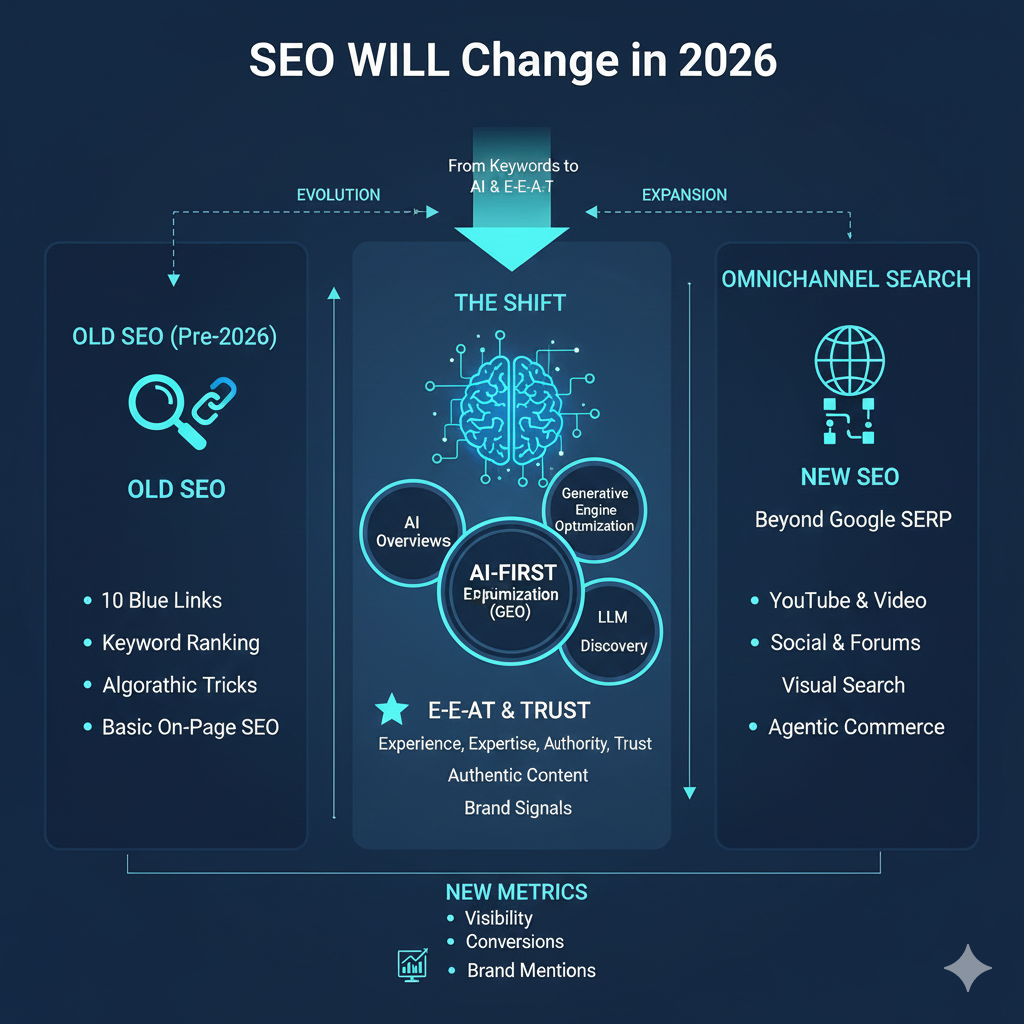
SEO is evolving faster than ever, and by 2026, Google’s AI, particularly its AI Overviews feature (formerly Search Generative Experience or SGE), will completely reshape how content ranks and appears in search results. To stay ahead, you need to understand what matters to AI and adjust your SEO strategy accordingly.
How Google AI Will Impact SEO
Google’s AI, including the Gemini family of models, doesn’t just crawl pages—it understands user intent, synthesizes information from multiple authoritative sources, and presents concise answers directly on the search results page.
This means traditional ranking factors like keyword stuffing or basic backlinks won’t be enough.
The AI now prioritizes content that is:
Google’s AI doesn’t just index pages—it understands user intent, synthesizes information from multiple trusted sources, and presents concise answers directly in search results.
Traditional SEO strategies like keyword stuffing, link quantity, or superficial content won’t cut it anymore. AI now prioritizes:
-
Authoritative, trustworthy content
-
Well-structured, easy-to-read content
-
Direct answers to user queries
In short, quality, clarity, and credibility are becoming more important than ever.
Key Factors :
1. E-E-A-T: Experience, Expertise, Authoritativeness, Trustworthiness
Google AI heavily favors content from experts or credible brands. Original research, case studies, and first-hand insights are more likely to be cited in AI snippets.
2. Structured Content
Headings (H1–H3), bullet points, tables, and lists make content easier for AI to scan and extract summaries. Well-organized pages are more likely to appear in AI Overviews.
3. Clarity and Conciseness
AI often pulls 40–60 word “answer blocks” to generate search snippets. Begin each section with a concise, direct answer to improve snippet eligibility.
4. Topical Authority
Creating topic clusters around a main subject demonstrates expertise. AI rewards comprehensive coverage of a topic rather than fragmented content.
5. Structured Data (Schema Markup)
Implementing FAQ, HowTo, Article, or Product schema helps AI understand your content’s purpose and details, increasing snippet visibility.
6. Technical SEO & User Experience
Fast-loading, mobile-friendly, and crawlable websites are essential. Poor site speed, broken links, or technical errors can prevent AI from indexing content correctly.
7. Natural Language Optimization
Content should answer questions users ask naturally, as in voice searches or AI assistants, e.g., “How do I optimize my website for Google AI?” instead of “website SEO tips.”
The Work Process to Dominate SEO in 2026
Step 1: Audit Existing Content
-
Identify high-performing pages and assess their AI-readiness (structure, clarity, E-E-A-T).
-
Prioritize pages that can be optimized for AI snippet inclusion.
Step 2: Map User Intent
-
Use AI tools to discover conversational queries users are likely to ask.
-
Align queries with specific sections or pages to ensure direct answers are available.
Step 3: Optimize Content for AI
-
Start each section with question-based headings (H2/H3).
-
Provide concise answers immediately after headings.
-
Use lists, tables, and short paragraphs.
-
Embed multimedia content like images or videos with descriptive alt text.
Step 4: Enhance E-E-A-T
-
Feature author bios with qualifications and links.
-
Cite authoritative sources and include original data or research.
-
Maintain factual consistency across platforms.
Step 5: Implement/Update Schema
-
Add FAQ, HowTo, Article, or Product schema to make content machine-readable.
-
Validate schemas to ensure AI can interpret them correctly.
Step 6: Monitor AI Visibility
-
Track how often content is cited in AI Overviews, not just traditional rankings or clicks.
-
Adjust content structure and update information based on AI visibility metrics.
Step 7: Continuous Improvement
-
Regularly refresh content to maintain topical authority.
-
Test new formats like interactive content, tables, and diagrams.
-
Collaborate with experts to provide genuine insights and experience.
Final Thoughts
SEO in 2026 will no longer be just about keywords and backlinks. It’s about combining human expertise with AI efficiency.