







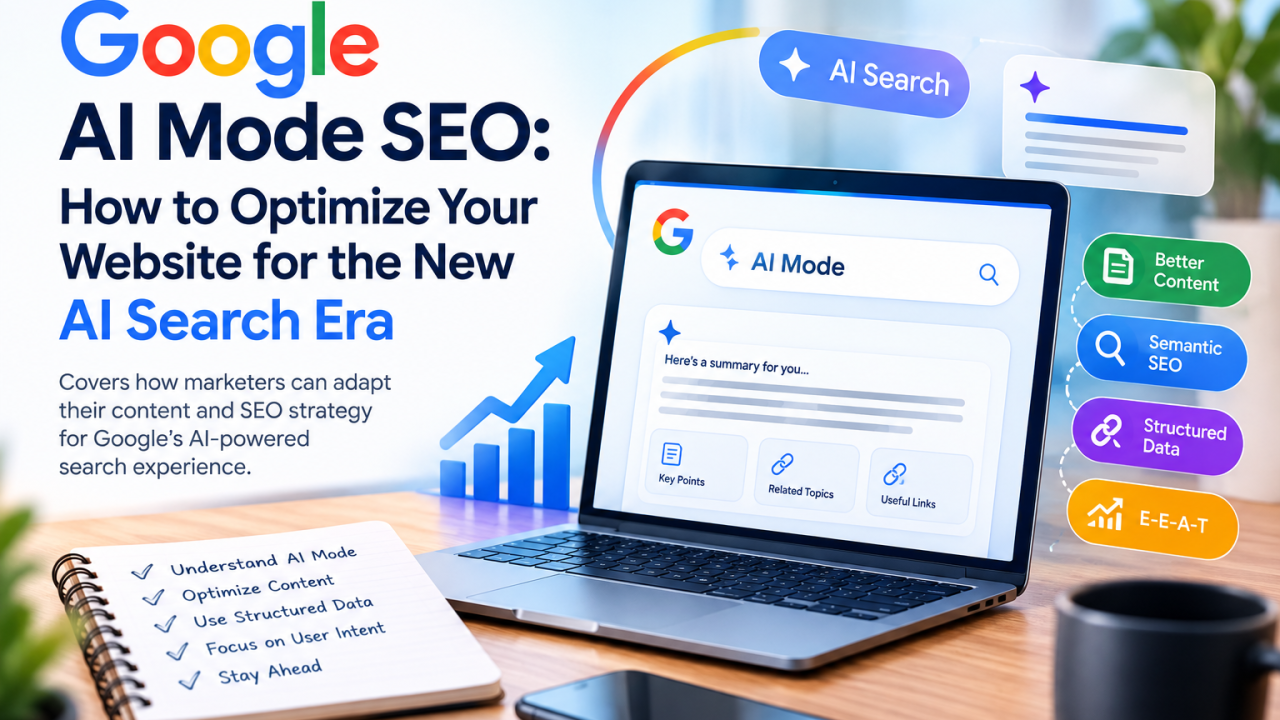
Search is changing rapidly. People are no longer using Google only to find a list of blue links. They are increasingly asking longer, more conversational questions and expecting AI-powered answers.
Google AI Mode is part of this transformation. It can break a complex question into related searches, explore information from multiple sources, and provide an AI-generated response with links to relevant websites.
For website owners, businesses, bloggers and SEO professionals, this creates an important question:
How do you optimize a website for Google AI Mode and other AI search experiences?
The good news is that you don’t need to abandon traditional SEO. Google itself says that its existing SEO fundamentals remain important for generative AI search experiences, including AI Mode and AI Overviews.
In this guide, we’ll explain Google AI Mode SEO, AI SEO, AI-assisted content creation, Google’s AI search, SEO costs, the best AI tools for SEO, and whether SEO is still worth investing in during 2026.
What Is Google AI Mode?
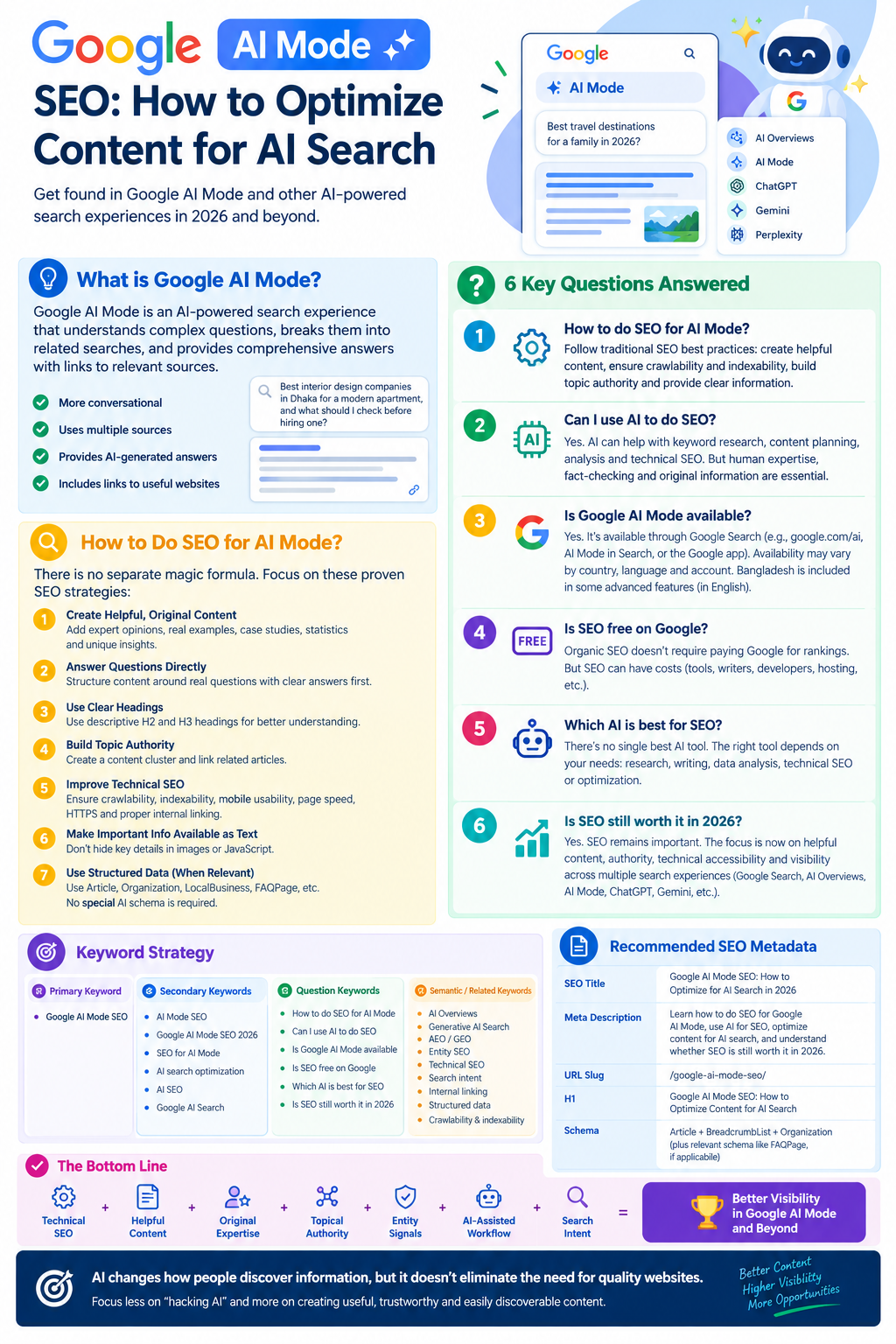
Google AI Mode is an AI-powered search experience designed to provide more comprehensive answers to complicated questions.
Instead of simply returning a traditional search results page, AI Mode can understand a user’s question, break it into multiple related searches and explore information from different sources.
Google describes this process as searching multiple subtopics simultaneously to find relevant information across the web.
For example, instead of searching:
“Best interior design company Dhaka”
a user might ask:
“What are the best interior design companies in Dhaka for a modern apartment, and what should I check before hiring one?”
AI-powered search can understand the different parts of that question and provide a more detailed response.
This means SEO is increasingly about being useful, relevant, trustworthy and easy for search systems to understand, rather than simply repeating a keyword.
How to Do SEO for AI Mode?
There is no separate magic formula for “AI Mode SEO.”
Google’s official guidance says that existing SEO best practices remain the foundation for appearing in generative AI features. Pages need to be indexed and eligible to appear in normal Google Search, and Google recommends focusing on helpful, reliable, people-first content.
Here are the most important strategies.
1. Create Helpful, Original Content
AI search systems need reliable information to generate useful answers.
Don’t create articles that simply rewrite information already available on hundreds of websites.
Instead, add:
- Original research
- Expert opinions
- Real examples
- Case studies
- Statistics
- First-hand experience
- Unique explanations
- Practical solutions
- Original images and videos
- Updated information
Google specifically recommends creating unique, valuable, non-commodity content for generative AI search.
2. Answer Questions Directly
AI search is highly conversational.
Therefore, structure your content around real questions.
For example:
Question:
How much does SEO cost in Bangladesh?
Start with a clear answer before providing additional details.
Then explain:
- SEO pricing factors
- Local SEO
- Technical SEO
- Content SEO
- Link building
- Monthly SEO packages
- Expected timeframe
This structure makes your content easier for both users and search systems to understand.
3. Use Clear H2 and H3 Headings
Use descriptive headings instead of vague headings.
For example:
Weak heading:
Our Services
Better heading:
What SEO Services Does a Small Business Need in 2026?
Specific headings make the purpose of each section clearer.
4. Build Topic Authority
Don’t publish only one article about your main keyword.
Create a content cluster.
For example, if your primary topic is AI SEO, you could publish:
- What Is AI SEO?
- Google AI Mode SEO Guide
- How to Optimize Content for AI Search
- AI SEO vs Traditional SEO
- AEO vs GEO vs SEO
- How ChatGPT Search Works
- How Gemini Search Works
- Best AI Tools for SEO
- How to Use AI for Keyword Research
- How to Use AI for Content Optimization
Then connect these articles with relevant internal links.
5. Improve Technical SEO
Your content cannot perform well if search engines cannot properly access it.
Google recommends maintaining a clear technical structure and ensuring pages are crawlable and indexable.
Important technical SEO elements include:
- Crawlability
- Indexability
- Mobile usability
- Page speed
- HTTPS
- Canonical URLs
- XML sitemap
- Internal linking
- Clean URL structure
- Proper robots.txt
- Correct redirects
- Accessible text content
Google also recommends checking your site through Search Console.
6. Make Important Information Available as Text
Don’t put all important information inside an image, video or JavaScript component.
Important business information should be available in crawlable text.
For example:
Business name: Ask Engine Ltd
Service: SEO, GEO & AEO
Location: Dhaka, Bangladesh
Website: Your website
Services: Technical SEO, Local SEO, AEO, GEO, Content SEO
This gives search systems clearer information about your business.
7. Use Structured Data Correctly
Structured data can help Google understand your content.
However, don’t assume that adding a special “AI schema” will automatically make your site appear in AI Mode.
Google states that there is no special schema.org structured data required specifically for AI Overviews or AI Mode.
Use appropriate structured data when it genuinely applies to your page, such as:
- Organization
- LocalBusiness
- Article
- Product
- BreadcrumbList
- Person
- Event
- FAQPage where applicable
The structured data should accurately represent visible information on the page.
Can I Use AI to Do SEO?
Yes.
AI can significantly improve an SEO workflow, but it should be treated as an assistant rather than a complete replacement for SEO expertise.
AI can help with:
- Keyword research
- Search intent analysis
- Content outlines
- Topic clustering
- Competitor analysis
- Meta title ideas
- Meta descriptions
- Content briefs
- Internal linking suggestions
- Content optimization
- FAQ generation
- Schema drafting
- Content gap analysis
- SEO audits
- Data analysis
- Content updates
However, blindly publishing AI-generated content is not a good SEO strategy.
The goal should be:
AI + human expertise + original information + SEO fundamentals.
For example:
AI generates an initial content outline → SEO specialist validates search intent → subject expert adds experience → editor checks accuracy → SEO specialist optimizes the final page.
That workflow is much stronger than simply asking an AI tool to “write a 2,000-word SEO article.”
Is Google AI Mode Available?
Yes. Google AI Mode is available.
Google’s current documentation says users can access AI Mode through Google Search, including by going to google.com/ai, selecting AI Mode in Search, or using the Google app where available.
Availability can vary by country, language, account and feature.
Google’s current documentation also lists Bangladesh among countries where certain advanced AI Mode features, including Gemini 3 Pro in AI Mode, are available in English.
Because Google continues to expand and modify AI Search features, availability should be checked against Google’s current documentation rather than relying on an old SEO article.
Is SEO Free on Google?
Google Search itself is free to use, and organic SEO does not require paying Google to rank a website.
You can:
- Create a website
- Publish content
- Submit a sitemap
- Use Google Search Console
- Optimize your website
- Build useful content
- Earn organic search visibility
without paying Google for organic rankings.
However, SEO itself can involve costs.
For example:
- SEO software
- Content writers
- SEO specialists
- Developers
- Website hosting
- Digital PR
- Link acquisition
- Photography/video
- Technical audits
- Content production
So the simple answer is:
Organic Google SEO can be done without paying Google for rankings, but professional SEO may have business and operational costs.
Which AI Is Best for SEO?
There isn’t one AI tool that is universally “the best” for every SEO task.
Different tools are useful for different workflows.
AI tools can help with:
Content research:
Finding topics, questions and content gaps.
Content writing:
Creating drafts, outlines and variations.
Keyword analysis:
Understanding search intent and keyword relationships.
Technical SEO:
Analyzing data, identifying patterns and assisting with troubleshooting.
Data analysis:
Processing Search Console, analytics and ranking data.
Content optimization:
Improving structure, clarity and topical coverage.
A professional SEO workflow may combine AI tools with traditional SEO platforms and first-party data.
Most importantly, don’t choose an AI tool simply because it claims to “guarantee Google rankings.”
Google itself warns website owners to be cautious about third-party tools claiming access to Google’s internal ranking or AI systems.
Is SEO Still Worth It in 2026?
Yes, SEO remains important in 2026—but SEO is evolving.
Google says SEO remains relevant for generative AI search because AI features are connected to Google’s core Search ranking and quality systems.
The bigger change is the way people discover information.
Traditional SEO focused heavily on:
Keyword → Ranking → Click
Modern search increasingly involves:
Question → Search → AI answer → Supporting sources → Website visit → Conversion
This means businesses should think beyond rankings alone.
A strong SEO strategy in 2026 should consider:
- Google Search
- AI Overviews
- Google AI Mode
- Local Search
- Google Maps
- Images
- Video
- ChatGPT
- Gemini
- Perplexity
- Brand mentions
- Entity recognition
- Content authority
- Conversion optimization
However, businesses should not chase every new “AI SEO hack.”
Google’s own 2026 guidance specifically recommends focusing on effective SEO rather than tactics such as unnecessary AI text files, artificial mentions or supposed AEO/GEO hacks.
SEO vs AEO vs GEO in 2026
These terms are increasingly used in the digital marketing industry.
SEO — Search Engine Optimization
Optimizing a website to improve visibility in search engines.
AEO — Answer Engine Optimization
A term commonly used for optimizing content to provide direct answers in answer-focused search experiences.
GEO — Generative Engine Optimization
A term commonly used for improving visibility in generative AI search experiences.
But there is an important point:
Google’s official position is that optimizing for generative AI search is still fundamentally part of optimizing for Google Search.
Therefore, businesses should not abandon traditional SEO fundamentals simply because AI search is growing.
How to Optimize Content for AI Search
Use this practical checklist:
Content
✓ Answer the searcher’s question directly
✓ Provide original information
✓ Demonstrate expertise
✓ Include examples
✓ Update outdated information
✓ Avoid unnecessary filler
✓ Use natural language
✓ Cover related questions
✓ Add useful statistics and evidence
✓ Create people-first content
Technical SEO
✓ Allow crawling
✓ Make important pages indexable
✓ Use HTTPS
✓ Improve mobile experience
✓ Improve page speed
✓ Build internal links
✓ Maintain XML sitemap
✓ Fix broken links
✓ Use appropriate structured data
AI Search Visibility
✓ Build topical authority
✓ Publish expert content
✓ Strengthen your brand/entity signals
✓ Create original research
✓ Publish useful visual content
✓ Build legitimate online references
✓ Monitor Google Search Console
✓ Track AI-search visibility where reporting is available
Google announced new Search Console insights for generative AI search, including information about impressions and pages appearing in AI responses. Google says these features have been rolled out worldwide as of August 31, 2026.
Future of SEO Is Not “SEO Is Dead”
SEO isn’t disappearing.
Instead, search is expanding.
A website may now need to be discoverable across:
Google Search → AI Overviews → Google AI Mode → Maps → Images → Video → ChatGPT → Gemini → Perplexity
The fundamental principle remains the same:
Create useful information that people want, make it accessible to search engines, and establish your website as a trustworthy source.
AI changes how information is discovered, but it does not eliminate the need for quality websites.
FAQ
How do I do SEO for Google AI Mode?
Use the same foundational SEO principles used for Google Search: create helpful original content, ensure pages are crawlable and indexable, use clear site architecture, build internal links, improve page experience and provide information in accessible text. Google says there are no special AI Mode SEO requirements.
Can I use AI to do SEO?
Yes. AI can assist with keyword research, content planning, analysis, optimization and technical SEO tasks. Human expertise, fact-checking and original information remain important.
Is Google AI Mode available?
Yes. Google AI Mode is available through Google Search in supported markets and languages. Availability and specific features can vary by location and account.
Is SEO free on Google?
Organic SEO does not require paying Google for rankings. However, businesses may spend money on SEO professionals, tools, content, development and other marketing activities.
Which AI is best for SEO?
There is no single AI tool that is best for every SEO task. The right choice depends on whether you need research, writing, data analysis, technical SEO or content optimization.
Is SEO still worth it in 2026?
Yes. Google continues to state that SEO best practices remain relevant to its generative AI search experiences. The focus is increasingly shifting toward helpful content, authority, technical accessibility and visibility across multiple search experiences.
Final Takeaway
Google AI Mode SEO is not about finding a secret AI ranking trick.
The strongest approach in 2026 is to combine:
Technical SEO + Helpful Content + Original Expertise + Topical Authority + Entity Signals + AI-Assisted Workflow + Search Intent
AI can help you work faster, but quality information and strong SEO fundamentals remain the foundation.
If your website wants to appear in Google Search and AI-powered search experiences, focus less on trying to “hack AI” and more on becoming a useful, trustworthy and easily discoverable source of information.