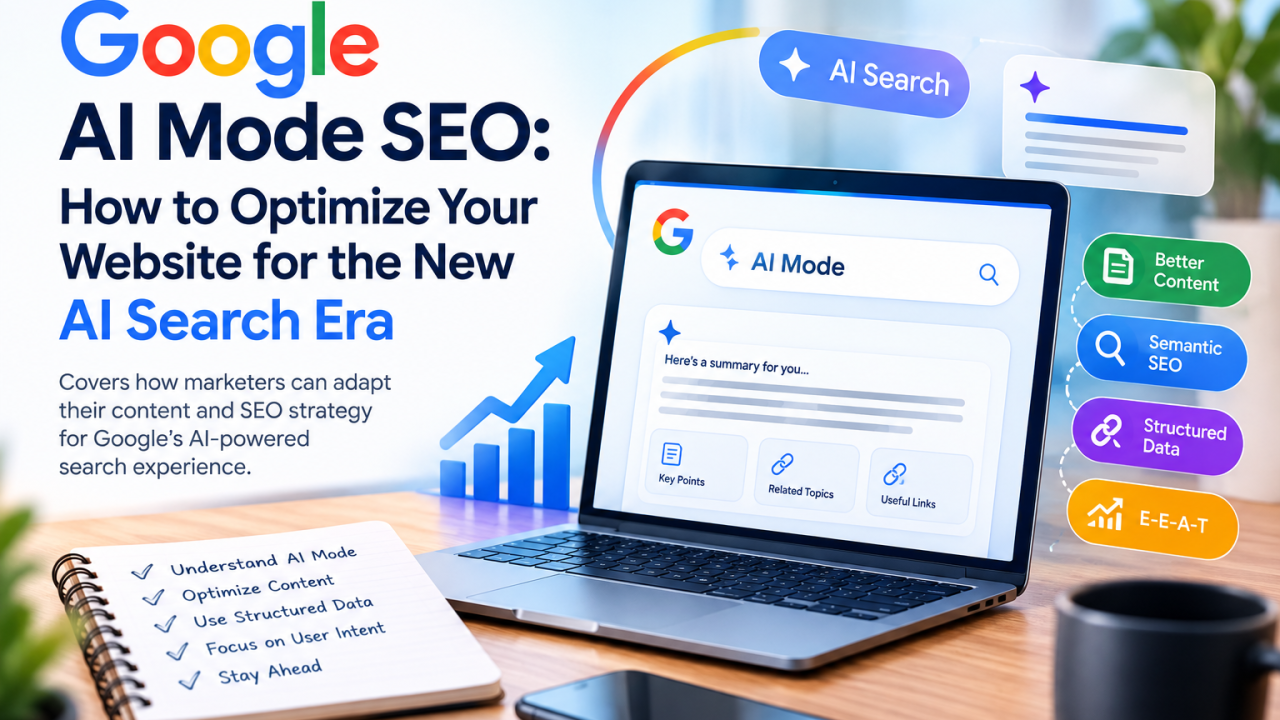








Search is changing rapidly. People no longer rely only on traditional Google search results to find information, products, services, and businesses. They are increasingly asking questions directly to AI-powered search and answer platforms such as ChatGPT, Google AI features, Microsoft Copilot, Gemini, and Perplexity.
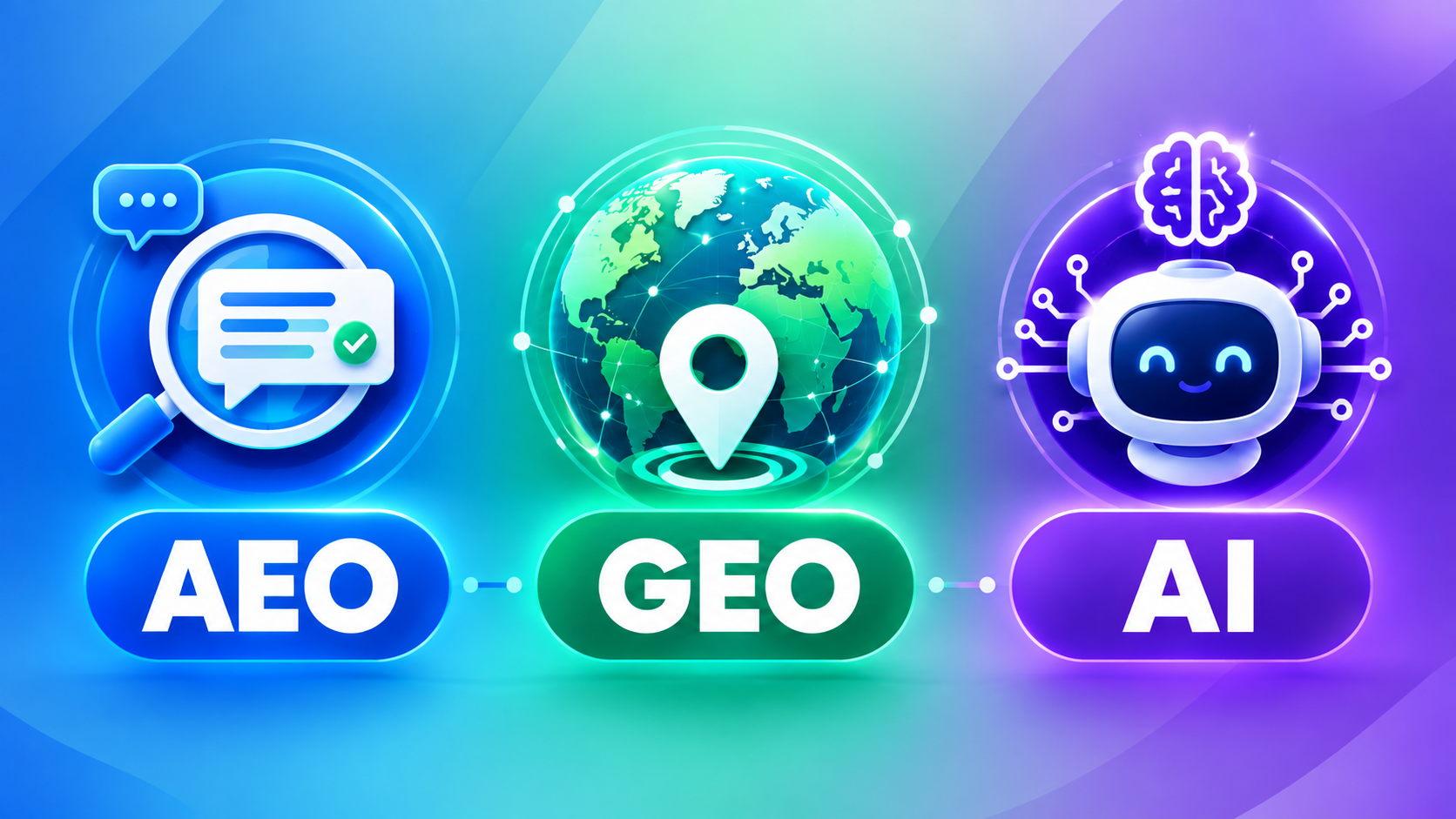
This shift has created two important digital marketing strategies: Answer Engine Optimization (AEO) and Generative Engine Optimization (GEO).
While traditional SEO (Search Engine Optimization) focuses primarily on improving visibility in search engine results, AEO focuses on providing direct answers to users’ questions, while GEO focuses on improving the likelihood that a brand, website, product, or business is mentioned and represented accurately in generative AI responses.
This guide explains how to do AEO and GEO, the difference between AEO and GEO, how to perform GEO optimization, and how SEO, AEO, and GEO work together.
What Is AEO?
AEO stands for Answer Engine Optimization.
AEO is the process of optimizing digital content so that answer engines can understand, extract, and potentially present the content as a useful answer to a user’s question.
Instead of targeting only keywords such as:
“interior design company Dhaka”
an AEO strategy also targets questions such as:
“What are the best interior design services in Dhaka?”
“How much does interior design cost in Dhaka?”
“What should I consider before hiring an interior designer?”
How AEO Works
AEO content should be:
- Clear
- Direct
- Well structured
- Factually supported
- Easy to understand
- Organized around real user questions
- Supported by relevant context and entities
Useful AEO formats include:
- FAQs
- Question-and-answer sections
- How-to guides
- Definitions
- Step-by-step tutorials
- Comparison pages
- Product information
- Service pages
- Expert explanations
What Is GEO?
GEO stands for Generative Engine Optimization.
GEO is an emerging optimization approach focused on improving how a website, organization, product, service, or brand is understood and represented in AI-generated search experiences.
Generative search systems may synthesize information from multiple sources before generating an answer.
Therefore, GEO is not simply about ranking one webpage for one keyword.
It is about building a strong, trustworthy, well-structured digital presence that AI systems can understand and potentially use when generating answers.
AEO and GEO in Digital Marketing
AEO and GEO are becoming important parts of modern digital marketing because users increasingly search through conversational and AI-powered interfaces.
Traditional SEO often asks:
“How can my webpage rank higher?”
AEO asks:
“How can my content provide the answer to the user’s question?”
GEO asks:
“How can my brand and content become understandable, relevant, and useful within generative AI search experiences?”
A modern digital marketing strategy can therefore combine:
SEO + AEO + GEO + Content Marketing + Digital PR + Brand Authority
Difference Between SEO, AEO and GEO
| Strategy | Main Focus | Typical Goal |
|---|---|---|
| SEO | Search engines | Improve organic search visibility |
| AEO | Answer engines | Provide direct answers to questions |
| GEO | Generative AI engines | Improve visibility and representation in AI-generated answers |
These strategies overlap considerably.
For example, a well-optimized service page can rank in Google, answer a conversational question, and provide information that an AI system can understand.
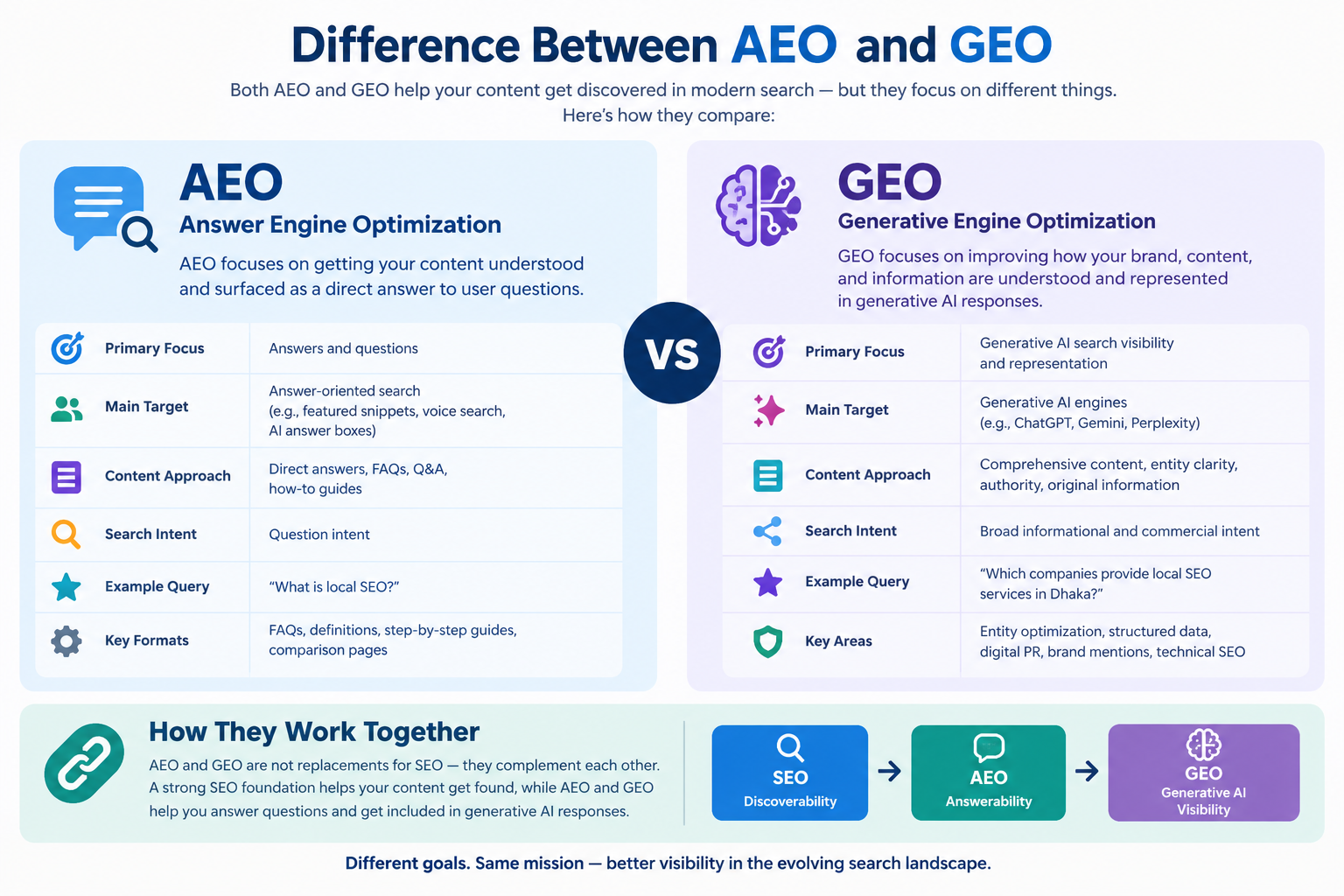
Difference Between AEO and GEO
Although AEO and GEO are closely related, they are not identical.
AEO
AEO primarily focuses on answering specific user questions.
Examples:
- What is SEO?
- How does Google Business Profile work?
- How much does local SEO cost?
- How do I optimize my website?
GEO
GEO focuses more broadly on how generative AI systems understand and synthesize information about a topic, organization, product, service, or brand.
For example, a GEO strategy might help establish consistent information about:
- Company identity
- Services
- Expertise
- Locations
- Products
- Authors
- Industry topics
- Brand reputation
- Third-party references
In simple terms:
AEO = Optimize for answers.
GEO = Optimize for generative AI discovery and representation.
How to Do AEO
AEO does not require creating a completely separate website. Instead, you can improve existing content to answer users’ questions more effectively.
1. Research Questions
Start by identifying questions your audience actually asks.
For example, an SEO agency could target:
- What is SEO?
- What is AEO?
- What is GEO?
- How does local SEO work?
- How does Google Maps SEO work?
- How can a business appear in AI search?
- What is generative engine optimization?
Use keyword research, customer questions, search suggestions, forums, community discussions, and website analytics to discover useful questions.
2. Create Direct Answers
Place a concise answer near the beginning of your content.
For example:
What is GEO optimization?
GEO optimization is the process of improving a brand’s digital content and online presence so that generative AI and AI-powered search systems can better understand and potentially reference the brand when responding to relevant user queries.
After the short answer, provide deeper explanation.
3. Use Clear Content Structure
Use:
- H1
- H2
- H3
- Short paragraphs
- Bullet points
- Numbered lists
- Tables
- FAQs
A clear structure helps both users and automated systems understand the relationships between topics.
4. Build Topic Authority
Instead of publishing one article about AEO, create a complete content cluster.
For example:
Main topic:
AEO Guide
Supporting articles:
- What is AEO?
- AEO vs SEO
- AEO vs GEO
- How to do AEO
- AEO tools
- AEO checklist
- AEO for local businesses
- AEO for ecommerce
- AEO for news websites
This creates a stronger topical information architecture.
How to Do GEO Optimization
GEO optimization should be approached as a broader digital presence strategy.
1. Create High-Quality Original Content
Publish useful content that provides genuine information rather than simply repeating generic AI-generated text.
Examples include:
- Original research
- Expert commentary
- Case studies
- Statistics
- Industry reports
- Detailed guides
- Original images
- Videos
- Demonstrations
- Customer experiences
Original information can provide additional context for both users and search systems.
2. Strengthen Entity Information
Make it easy to understand:
Who are you?
What do you do?
Where do you operate?
Who do you serve?
What are you known for?
For a business, clearly communicate:
- Company name
- Official website
- Address
- Phone
- Services
- Locations
- Founders
- Team
- Industry
- Areas served
- Social profiles
Consistency across reputable sources can help establish a clearer digital identity.
3. Optimize Your About and Service Pages
Your website should clearly explain your organization.
For example:
About Us
- Company history
- Expertise
- Team
- Location
- Experience
- Credentials
Service Pages
- What the service is
- Who needs it
- How it works
- Benefits
- Process
- Pricing information where appropriate
- FAQs
- Contact information
4. Use Structured Data
Relevant structured data can help search engines understand website entities and content.
Depending on the website, useful Schema.org types may include:
- Organization
- LocalBusiness
- Person
- Article
- NewsArticle
- Product
- Service
- FAQPage
- BreadcrumbList
- WebSite
Structured data should accurately describe visible and relevant information on the page.
It should not be used to create misleading claims.
How to Do Generative Engine Optimization
Generative Engine Optimization can be approached through several interconnected areas.
Step 1: Build topical authority
Create comprehensive resources around your primary subject.
Step 2: Improve factual clarity
Use clear statements, definitions, dates, names, locations, and supporting evidence.
Step 3: Strengthen your brand entity
Ensure consistent information across your website and reputable external sources.
Step 4: Publish original information
Create research, case studies, statistics, expert insights, and useful resources.
Step 5: Earn legitimate mentions
Digital PR, industry publications, professional organizations, interviews, and other reputable references can contribute to broader online visibility.
Step 6: Improve technical accessibility
Make sure search systems can crawl and understand your website.
Important technical areas include:
- HTTPS
- Mobile usability
- Page performance
- Crawlability
- Indexability
- XML sitemap
- Internal linking
- Canonical URLs
- Robots directives
- Clean URL structure
SEO + AEO + GEO Extension
Many marketers now think of SEO, AEO, and GEO as three connected layers.
SEO
Helps users discover your website through search.
AEO
Helps your content answer specific questions.
GEO
Helps build a broader digital presence that can be understood within generative search experiences.
A practical framework is:
SEO → Discoverability
AEO → Answerability
GEO → Generative visibility
AEO, GEO Optimization Strategy
A combined strategy can follow this workflow:
1. Keyword Research
Identify:
- Commercial keywords
- Informational keywords
- Long-tail keywords
- Conversational queries
- Local searches
- Question-based searches
2. Search Intent Analysis
Determine whether the user wants:
- Information
- Comparison
- Navigation
- A product
- A service
- A local business
- A solution
3. Content Creation
Create content that directly satisfies the search intent.
4. Entity Optimization
Clearly connect:
Brand → Service → Location → People → Industry → Website
5. Technical SEO
Improve:
- Crawlability
- Indexability
- Performance
- Internal links
- Structured data
- Mobile experience
6. Authority Building
Develop legitimate references through:
- Digital PR
- Industry publications
- Expert contributions
- Partnerships
- Original research
- Professional profiles
7. Measurement
Track visibility across traditional search and relevant AI-powered search experiences.
What Is a GEO AI Optimization Strategy?
GEO AI optimization refers to optimizing a digital presence for the way generative AI systems discover, interpret, summarize, and present information.
A practical GEO AI strategy can include:
- Entity optimization
- Original content
- Topical authority
- Technical SEO
- Structured data
- Digital PR
- Brand mentions
- Author expertise
- Local SEO
- Content freshness
- Consistent business information
It is important to understand that no optimization method can guarantee that a particular AI system will mention a website or brand.
AI systems can change their retrieval, ranking, training, and answer-generation processes.
AEO & GEO Checker
A useful AEO and GEO checker should examine more than traditional keyword rankings.
A comprehensive audit can review:
Website
- Technical SEO
- Crawlability
- Indexability
- Page speed
- Mobile usability
- Internal linking
Content
- Question coverage
- Direct answers
- Content structure
- Topical authority
- Original information
- Content freshness
Entity
- Organization information
- Author information
- Location
- Services
- Brand consistency
Structured Data
- Organization Schema
- Person Schema
- Article Schema
- LocalBusiness Schema
- Service Schema
- Breadcrumb Schema
AI Search Visibility
Track relevant queries across available AI search experiences and record:
- Whether the brand appears
- How the brand is described
- Which pages are referenced
- Whether information is accurate
- Which competitors or sources appear
- What information is missing
Because AI-generated results can vary, AI visibility checks should be treated as snapshots rather than permanent rankings.
How to Measure AEO and GEO Performance
Traditional SEO metrics include:
- Organic traffic
- Keyword rankings
- Impressions
- Click-through rate
- Backlinks
- Indexed pages
AEO metrics can additionally include:
- Question rankings
- Featured answer visibility
- FAQ visibility
- Long-tail search performance
- Organic CTR
GEO measurement can include:
- AI mentions
- Brand citations
- AI-generated references
- Entity accuracy
- Source inclusion
- Brand sentiment/context monitoring
- Referral traffic where available
AEO and GEO for Local Businesses
Local businesses can combine:
Local SEO + AEO + GEO
For example, a Dhaka interior design company could create content around:
- Interior design company in Dhaka
- Interior designer in Gulshan
- Office interior design in Dhaka
- Apartment interior design in Uttara
- Interior design cost in Bangladesh
- Best questions to ask an interior designer
- Modern office interior design ideas
The website should also clearly provide:
- Business name
- Address
- Phone
- Service areas
- Projects
- Reviews
- Company information
- Team information
- Contact details
AEO and GEO for News Websites
News publishers can focus on:
- Clear headlines
- Accurate publication dates
- Author information
- Article structured data
- Original reporting
- Strong internal linking
- Source attribution
- Updated information
- Clear topic categorization
For news content, factual accuracy and transparent sourcing are particularly important because AI systems may summarize articles and combine information from multiple sources.
Common AEO and GEO Mistakes
Mistake 1: Writing Only for Keywords
Keyword optimization remains useful, but modern search requires content that satisfies user intent.
Mistake 2: Creating Generic AI Content
Large quantities of generic content do not automatically create authority.
Mistake 3: Ignoring Entity Information
A website should clearly explain who operates it, what it does, and where it operates.
Mistake 4: Creating Fake Reviews or Mentions
Artificial reputation signals can create trust and compliance problems.
Mistake 5: Ignoring Technical SEO
AI-focused optimization does not replace basic technical SEO.
Mistake 6: Expecting Instant AI Visibility
Generative search visibility can vary by query, system, location, source availability, and time.
AEO and GEO Checklist
Use this checklist when auditing a website:
SEO
☐ Keyword research
☐ Search intent
☐ Technical SEO
☐ Internal linking
☐ Mobile optimization
☐ Page performance
☐ XML sitemap
☐ Indexability
AEO
☐ Question-based content
☐ Direct answers
☐ FAQs
☐ How-to content
☐ Clear headings
☐ Structured content
☐ Conversational queries
GEO
☐ Strong entity information
☐ Original content
☐ Expert authorship
☐ Digital PR
☐ Reputable mentions
☐ Consistent business information
☐ Structured data
☐ AI visibility monitoring
FAQ:
What is the difference between AEO and GEO?
AEO focuses on optimizing content to provide useful answers to user questions. GEO focuses more broadly on improving how a brand, website, or topic is understood and represented within generative AI search experiences.
Is AEO replacing SEO?
No. AEO is better understood as a complementary approach to traditional SEO. Search engines still depend heavily on crawlable, accessible, relevant, and useful web content.
Is GEO the same as AI SEO?
The terms are sometimes used interchangeably in marketing discussions, but they can describe different scopes. AI SEO is a broad term for optimizing visibility in AI-influenced search experiences, while GEO specifically emphasizes generative engines.
How can I improve my website for ChatGPT and AI search?
Build useful original content, clearly explain your organization and expertise, maintain accurate entity information, improve technical accessibility, develop authoritative references, and monitor how your brand appears for relevant queries.
What is an AEO and GEO checker?
An AEO and GEO checker is an audit or monitoring system that evaluates a website’s ability to provide direct answers and its visibility or representation within generative AI search experiences.
Does schema guarantee AI visibility?
No. Structured data can help machines understand information, but it does not guarantee rankings, citations, or inclusion in AI-generated answers.
Final Thoughts
The future of search is becoming increasingly conversational and multimodal. Users may discover businesses, products, services, and information through traditional search engines as well as AI-powered answer and generative search systems.
For that reason, businesses should not think of SEO, AEO, and GEO as completely separate disciplines.
A strong strategy combines:
SEO for discoverability
AEO for answering questions
GEO for generative search visibility
The most sustainable approach is to create useful, original, technically accessible, factually clear content that genuinely helps users. Instead of trying to optimize for one particular AI system, build a strong digital presence that can be understood across search engines, answer engines, and generative search experiences.