








The way people search is changing fast. Traditional search engines are no longer the only gateway to information. Today, users are asking questions directly to AI-powered systems like ChatGPT, voice assistants, and smart search interfaces. This shift has introduced a new concept: Ask Engine Optimization .
If you’re a web developer, this isn’t just another marketing buzzword. It’s a structural change in how content is discovered, interpreted, and delivered. And the good news? You’re in a powerful position to shape how websites perform in this new era.
Let’s break it down step by step.
What Is Ask Engine Optimization?
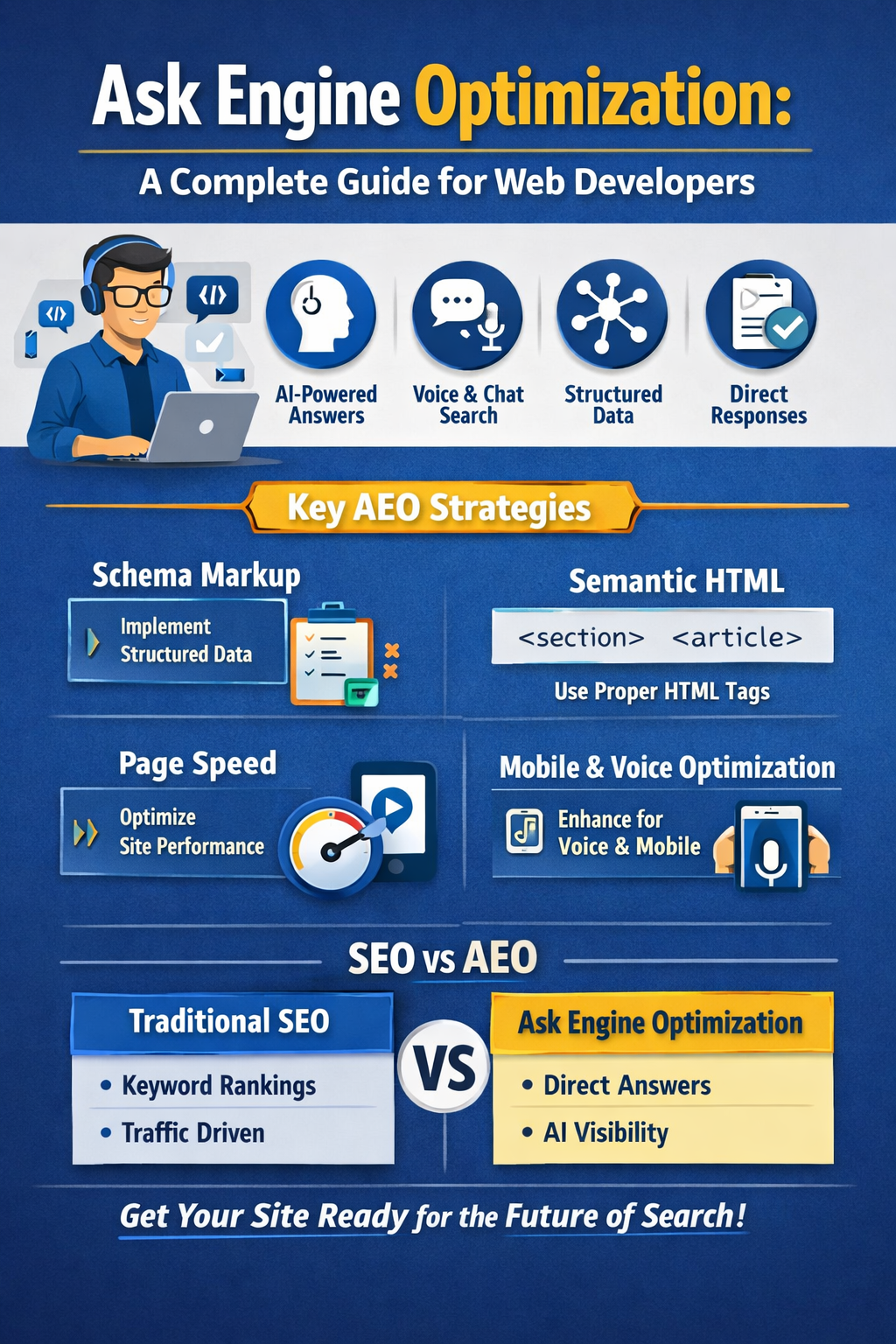
Ask Engine Optimization (AEO) is the process of optimizing websites and content so they can be easily understood, extracted, and delivered by AI-driven answer engines.
Unlike traditional SEO, which focuses on ranking pages in search engine results, AEO focuses on:
-
Providing direct, precise answers
-
Structuring content for AI comprehension
-
Optimizing for voice and conversational queries
-
Making data machine-readable
In simple terms:
SEO helps you rank.
AEO helps you get quoted.
Why Web Developers Should Care About AEO
You might think optimization is the marketer’s job. But here’s the truth — AEO is heavily technical.
Search engines and AI systems rely on:
-
Structured data
-
Clean HTML
-
Semantic markup
-
Page speed
-
Accessibility standards
-
Logical information architecture
These are all developer responsibilities.
If content is poorly structured, no amount of great writing will make it easily retrievable by AI systems.
How Ask Engines Work
Before optimizing, you need to understand how answer engines operate.
AI-driven systems:
-
Crawl and index content
-
Extract structured and semantically clear information
-
Analyze context
-
Generate concise answers
They prefer content that is:
-
Clearly organized
-
Directly answering a question
-
Supported by structured data
-
Technically optimized
If your site is messy, slow, or poorly structured, it becomes invisible in AI-generated responses.
SEO vs AEO: What’s the Difference?
Let’s compare.
| Traditional SEO | Ask Engine Optimization |
|---|---|
| Focuses on rankings | Focuses on direct answers |
| Optimizes for keywords | Optimizes for questions |
| Targets SERP visibility | Targets AI extraction |
| Backlink heavy | Structure and clarity heavy |
| Click-driven | Answer-driven |
SEO brings traffic.
AEO builds authority.
And in many cases, they work best together.
Core Components of Ask Engine Optimization
1. Structured Data (Schema Markup)
Structured data helps AI systems understand what your content represents.
Developers should implement:
-
FAQ schema
-
How-to schema
-
Article schema
-
Product schema
-
Organization schema
Schema acts like a translator between your content and AI systems.
Without it? You’re speaking in code. With it? You’re speaking in clarity.
2. Semantic HTML
Semantic HTML is not optional anymore.
Instead of using generic div elements, use:
-
<article> -
<section> -
<header> -
<nav> -
<aside> -
<footer>
Semantic structure helps machines understand content hierarchy.
Think of it like giving your content a logical skeleton.
3. Question-Based Content Structure
Ask engines prioritize content that answers specific questions.
Developers can support this by:
-
Structuring content with clear H2/H3 questions
-
Ensuring clean heading hierarchy
-
Using collapsible FAQ sections
-
Implementing anchor links for quick navigation
Clear structure increases answer extraction probability.
4. Page Speed Optimization
Speed matters more than ever.
AI systems prioritize fast-loading, technically sound websites. Improve speed by:
-
Minimizing JavaScript
-
Using lazy loading
-
Compressing images
-
Implementing CDN
-
Reducing server response time
Slow sites lose visibility.
5. Mobile and Voice Optimization
Many ask-engine queries come from mobile and voice searches.
Optimize by:
-
Using conversational language
-
Ensuring mobile responsiveness
-
Improving accessibility
-
Supporting natural language patterns
If your site doesn’t work smoothly on mobile, it won’t thrive in AI-driven results.
Technical Best Practices for AEO
Clean URL Structure
Use:
example.com/ask-engine-optimization-guide
Avoid:
example.com/page?id=34567&ref=xyz
Simple URLs improve indexing clarity.
Internal Linking Strategy
Help AI systems understand content relationships.
-
Link related articles
-
Use descriptive anchor text
-
Build topic clusters
This strengthens contextual understanding.
Improve Crawlability
Ensure:
-
Proper robots.txt configuration
-
XML sitemap submission
-
No broken links
-
Logical site architecture
If AI can’t crawl it, it can’t answer from it.
Optimizing for Featured Snippets and AI Answers
Featured snippets are stepping stones to AEO success.
Structure content like this:
-
Short answer paragraph (40–60 words)
-
Bullet lists
-
Tables
-
Step-by-step instructions
Answer first. Elaborate later.
This format increases extraction chances.
Content Formatting That Helps Ask Engines
Use:
-
Clear headings
-
Short paragraphs
-
Bullet lists
-
Numbered steps
-
Bold emphasis for key terms
Avoid:
-
Long text walls
-
Overstuffed keywords
-
Unstructured content
Readable content equals extractable content.
The Role of APIs and Structured Content Delivery
Modern web apps often use APIs to serve content.
Ensure:
-
Consistent data formatting
-
Proper metadata
-
Structured JSON responses
-
Headless CMS optimization
Structured backend systems improve frontend discoverability.
Common Mistakes Developers Make
Let’s be honest. These happen often:
-
Ignoring schema markup
-
Using divs for everything
-
Overcomplicating JavaScript rendering
-
Blocking bots unintentionally
-
Forgetting accessibility tags
Small technical mistakes can limit AEO performance dramatically.
Measuring AEO Performance
Unlike SEO, AEO doesn’t always show direct click metrics.
Instead, track:
-
Featured snippet presence
-
Brand mentions in AI answers
-
Structured data validation
-
Search Console rich result reports
-
Increased authority queries
AEO is about influence, not just traffic.
The Future of Ask Engine Optimization
Search is shifting toward conversational interfaces.
AI systems are becoming:
-
More contextual
-
More conversational
-
More precise
Web developers who embrace structured, machine-readable content today will dominate tomorrow’s digital ecosystem.
This isn’t a trend. It’s a transformation.
Practical AEO Implementation Checklist
Here’s a quick developer-focused checklist:
-
Implement schema markup
-
Use semantic HTML
-
Improve page speed
-
Optimize for mobile
-
Structure content with clear questions
-
Create clean URLs
-
Strengthen internal linking
-
Ensure crawlability
-
Validate structured data
-
Reduce unnecessary JavaScript
Simple steps. Powerful results.
Conclusion
Ask Engine Optimization (AEO) is evolving SEO. Learn how clean code, semantic markup, and performance help AI understand your content and boost future visibility.
For web developers, AEO is a technical advantage. It rewards clean code, logical structure, semantic markup, and performance optimization.
FAQs
1. Is Ask Engine Optimization replacing traditional SEO?
No. AEO complements SEO. Traditional SEO drives traffic, while AEO focuses on being selected as a direct answer in AI systems.
2. Do I need schema markup for AEO?
Yes. Structured data significantly improves AI understanding and increases the chances of answer extraction.
3. How is AEO different from voice search optimization?
Voice search is part of AEO. AEO covers all AI-driven answer systems, not just voice assistants.
4. Can small websites benefit from AEO?
Absolutely. Clear structure and direct answers can outperform larger sites if optimized correctly.
5. What is the most important technical factor for AEO?
Structured data combined with semantic HTML and fast loading speed are the top technical foundations.