







Ranking your online store on search engines isn’t just about keywords anymore—it’s about understanding users, predicting behavior, and delivering personalized experiences. That’s where Artificial Intelligence (AI) steps in and completely transforms the game.
Think of AI as your behind-the-scenes strategist. It analyzes massive amounts of data, learns from user interactions, and continuously improves how your e-commerce site performs in search results. Whether you’re running a small Shopify store or a large-scale marketplace, AI can be the difference between being invisible and dominating search rankings.
So, how exactly does AI improve e-commerce SEO? Let’s break it down in a simple, practical, and engaging way.
What Is AI in E-Commerce SEO?
AI in e-commerce SEO refers to the use of machine learning, natural language processing (NLP), and automation to improve how online stores rank on search engines like Google. Instead of manually analyzing keywords or guessing what customers want, AI systems process data in real time and make smart decisions.
Imagine trying to understand thousands of customer searches every day. That’s nearly impossible for a human. But AI can analyze patterns instantly—what people search, how they click, what they buy—and use that data to optimize your website.
This means your product pages, blog content, and even images can be automatically optimized based on real user behavior, not assumptions.
Role of Machine Learning in SEO
Machine learning is the brain behind AI. It allows systems to learn from data and improve over time without being explicitly programmed. In SEO, this means:
- Identifying trending keywords automatically
- Predicting user intent
- Adjusting content strategies based on performance
Search engines themselves use AI. Google’s algorithms, like RankBrain, rely heavily on machine learning to deliver better results. So, if your e-commerce store isn’t using AI, you’re already behind.
Why AI Matters for Search Rankings
Search engines are no longer just matching keywords—they’re understanding context and intent. AI helps e-commerce businesses align with this shift.
When someone searches for “best running shoes for beginners,” Google doesn’t just look for those exact words. It analyzes the meaning behind the query. AI helps your store match that intent by optimizing content accordingly.
Without AI, you’re basically guessing. With AI, you’re making data-driven decisions.
Changing Search Engine Algorithms
Search algorithms are evolving rapidly. AI-driven updates prioritize:
- User experience
- Content relevance
- Page performance
- Engagement metrics
This means traditional SEO tactics alone won’t work. AI helps you adapt quickly and stay ahead of algorithm changes.
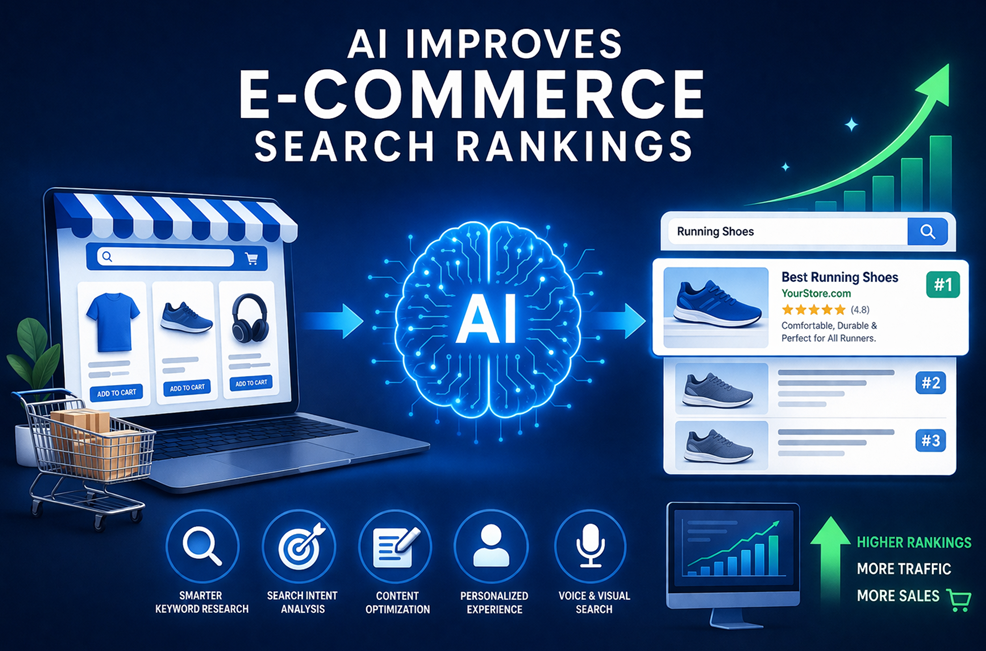
Key Ways AI Improves Rankings
Smarter Keyword Research AI tools can analyze millions of search queries and identify high-value keywords that humans might miss. Instead of focusing only on high-volume keywords, AI finds long-tail keywords that convert better.
For example, instead of targeting “shoes,” AI might suggest “affordable waterproof hiking shoes for women.” These keywords are more specific and less competitive, making it easier to rank.
Search Intent Analysis
Understanding what users really want is the secret to ranking higher. AI analyzes search patterns to determine whether a user is:
- Looking for information
- Comparing products
- Ready to buy
This allows you to create content that matches each stage of the buyer journey.
Content Optimization
AI tools can evaluate your content and suggest improvements based on:
- Keyword usage
- Readability
- Structure
- Competitor analysis
It’s like having a personal SEO expert reviewing your content 24/7. AI ensures your product descriptions and blog posts are optimized for both search engines and users.
Personalized User Experience
AI tracks user behavior and delivers personalized experiences. For example:
- Showing relevant products
- Recommending similar items
- Customizing homepage content
This improves engagement, reduces bounce rates, and increases conversions—all of which positively impact search rankings.
Voice Search Optimization
With the rise of voice assistants, AI helps optimize your content for voice search queries, which are usually longer and more conversational.
Instead of typing “laptop under $1000,” users might say, “What’s the best laptop under $1000 for students?” AI helps you adapt to these natural language queries.
Visual Search Enhancements
AI-powered visual search allows users to search using images instead of text. This is especially important for e-commerce.
By optimizing images with AI, you can:
- Improve image recognition
- Increase visibility in visual search results
- Drive more traffic from platforms like Google Lens
AI Tools for E-Commerce SEO
Here’s a quick comparison of popular AI-powered SEO tools:
| Tool | Key Feature | Best For |
|---|---|---|
| Surfer SEO | Content optimization | Bloggers & stores |
| Jasper AI | AI content writing | Marketing teams |
| SEMrush AI | Keyword research | Advanced SEO |
| Ahrefs AI | Backlink analysis | SEO professionals |
| Frase | Content briefs | Content creators |
These tools simplify complex SEO tasks and help you focus on strategy rather than manual work.
Benefits of AI in E-Commerce SEO
AI offers several powerful advantages:
- Faster decision-making using real-time data
- Improved accuracy in keyword targeting
- Better user experience through personalization
- Higher conversion rates
- Scalability for large product catalogs
It’s like upgrading from a bicycle to a high-speed train—you move faster and reach further.
Challenges of Using AI
While AI is powerful, it’s not perfect. Some challenges include:
- High initial cost
- Learning curve for beginners
- Over-reliance on automation
- Data privacy concerns
The key is to use AI as a tool, not a replacement for human creativity.
Future of AI in E-Commerce SEO
The future is incredibly exciting. AI will continue to evolve and bring innovations like:
- Predictive SEO strategies
- Hyper-personalized shopping experiences
- Advanced voice and visual search
- AI-generated content with human-like quality
E-commerce businesses that adopt AI early will have a massive competitive advantage.
Conclusion
AI is no longer optional—it’s essential for e-commerce success. From smarter keyword research to personalized user experiences, AI helps businesses rank higher, attract more traffic, and increase sales.
If you want your online store to stand out in a crowded marketplace, embracing AI is the smartest move you can make.
FAQs
1. How does AI help in SEO?
AI analyzes data, predicts trends, and optimizes content to improve search rankings.
2. Is AI necessary for e-commerce SEO?
Yes, it helps businesses stay competitive and adapt to changing algorithms.
3. Can AI replace SEO experts?
No, AI supports experts but cannot replace human strategy and creativity.
4. What is the best AI tool for SEO?
It depends on your needs, but tools like SEMrush and Surfer SEO are popular.
5. Does AI improve conversion rates?
Yes, by personalizing user experiences and targeting the right audience.